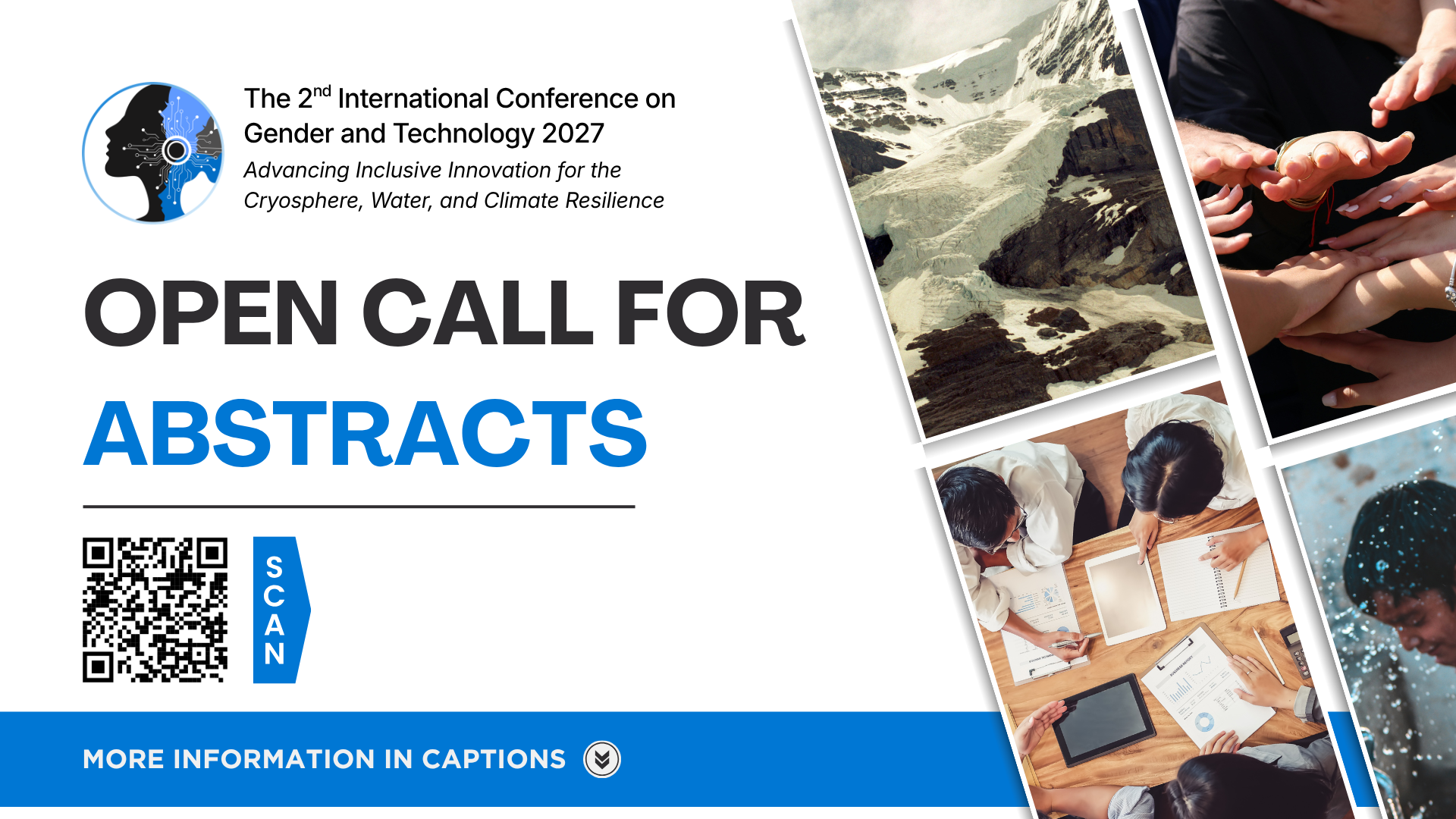
The UNESCO Chair in Mountain Cryosphere and Water invites researchers, practitioners, policymakers, and knowledge holders to submit abstracts for ICGT 2027. This conference, co-organized by The Small Earth Nepal and UNESCO with Tribhuvan University, Kathmandu University and Amrita Vishwa Vidyapeetham serving as academic partners will bring together participants from research, government, civil society, communities, media, development organizations, and the private sector to examine how gender, power, and knowledge shape science and technology for climate resilience.
The UNESCO Chair in Mountain Cryosphere and Water invites partners, academic institutions, civil society organizations (CSOs), collectives, and individuals to propose sessions for the 2nd International Conference on Gender and Technology (ICGT 2027). The conference, co-organized by The Small Earth Nepal and UNESCO with Tribhuvan University, Kathmandu University and Amrita Vishwa Vidyapeetham serving as academic partners will bring together participants from research, government, civil society, communities, media, development organizations, and the private sector to examine how gender, power, and knowledge shape science and technology for climate resilience.
Session Formats
We invite proposals under the following session formats:
- Interactive Workshops and Skill-Building Sessions: Hands-on sessions where participants gain practical tools, methods, or competencies relevant to gender, technology, and climate resilience
- Thematic Panel Discussions: Curated dialogues featuring diverse voices on issues aligned with the conference themes
- Cross-Sector Dialogue Spaces: Structured formats bridging academia, industry, policy, and civil society to co-design solutions
- Youth and Emerging Leaders’ Forums: Dedicated spaces for the next generation to lead discussions and present their perspectives
- Creative and Experimental Formats: Innovative approaches that advance the conference objectives
Sessions should connect to one or more of the three conference themes:
Theme 1: Gendered impacts of cryosphere and water change, and of climate technologies
How the benefits, burdens, risks and opportunities of cryosphere and water change, and of the technologies developed in response, differ across gender and social groups.
Topics may include:
- water security and risk in glacier- and snow-fed systems, GLOFs, WASH and climate information
- water-linked livelihood and infrastructure technologies, for example irrigation, agriculture and energy that depend on water
- access to finance and digital systems, and the distribution of paid and unpaid work
- gender-inclusive data and communication systems, including AI governance and disaster risk communication
Theme 2: Gendered, Indigenous and local knowledge in cryosphere, water, and climate technology and policy
How gendered, Indigenous and local knowledge of cryosphere and water systems is used, or overlooked, in the design of technologies, early warning systems and adaptation measures, and in water policy decisions, and how formal science can work with this knowledge in respectful, non-extractive ways.
Topics may include:
- how knowledge held by women and communities is recognized or excluded in technology and policy processes
- co-creation, consent and ethical engagement across knowledge systems in technology design and implementation
- women-led community innovation that retains agency and control over its knowledge
- integrating water, climate and ecosystem values into technology and policy
Theme 3: Representation, leadership and participatory governance
Who participates and leads in cryosphere, water and climate governance, and how this shapes which knowledge reaches policy.
Topics may include:
- underrepresentation and tokenism in cryosphere, water and climate institutions, policy processes and finance
- barriers to decision-making power, training, mentoring, and funding for women in cryosphere, water and climate leadership
- pathways for girls, youth and early-career women into cryosphere, water, and climate technology and governance careers
- gender-responsive science, technology and innovation (STI) indicators for cryosphere, water and climate, and their evidence gaps
Who Can Propose a Session?
Academic institutions, research centers, NGOs and CSOs, community-based organizations, collectives and cooperatives, private sector and social enterprises, government agencies, youth networks, and individuals with facilitation experience are all welcome to submit. We particularly encourage proposals led by or centered on women, youth, gender-diverse people, Indigenous and local knowledge holders, and communities from climate-affected regions.
Submission Criteria
- Session proposals must be submitted in English.
- Each proposal should include the session title, chosen format, linked conference theme(s), facilitator name(s) and affiliation(s), contact email, and a short biography* (max 100 words per facilitator).
- Provide a session description (max 250 words) outlining the purpose, intended participants, planned activities, and expected outcomes.
- Sessions are typically allocated 60–90 minutes. Please indicate your preferred duration.
- Joint proposals from two or more organizations or sectors (e.g., academia + CSO) are strongly encouraged.
- All sessions will be reviewed for alignment with the conference themes, participatory design, inclusivity of diverse voices, and respectful engagement practices, particularly where sessions involve communities or Indigenous and local knowledge.
Submit via: https://forms.cloud.microsoft/r/knt84fkfCx
Review Process
All submissions will be reviewed by the organizing Committee for relevance to the conference themes, quality and feasibility of the session design, inclusivity, and contribution to cross-sector learning and collaboration.
Important Dates
Submit your abstract by 15 December 2026
Receive notification of acceptance by 10 January 2027
Conference dates on 18–19 March 2007
Participation support
Limited scholarships are available for travel and participation support, prioritizing women, youth, Indigenous and local knowledge holders, and participants from climate-affected areas. Details on how to apply will follow.
Contact
For questions regarding abstract submission, please contact: icgt@smallearth.org.np
For queries about the conference, please contact Conference Secretariat, Rahul G. Rajkarnikar: rahul.rajkarnikar@smallearth.org.np